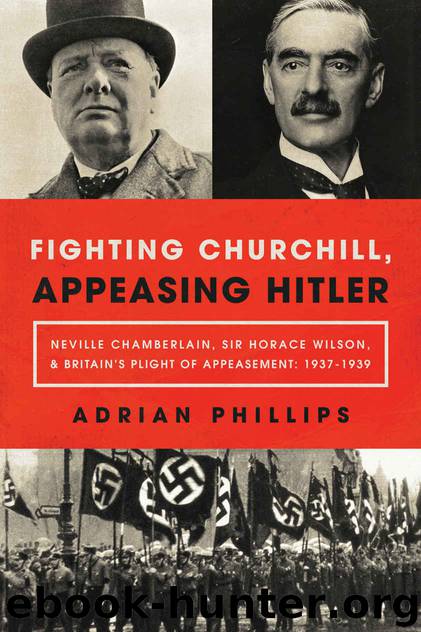
Fighting Churchill, Appeasing Hitler: Neville Chamberlain, Sir Horace Wilson, & Britain's Plight of Appeasement: 1937-1939 by Adrian Phillips
Author:Adrian Phillips [Phillips, Adrian]
Language: eng
Format: azw3
Publisher: Pegasus Books
Published: 2019-12-02T16:00:00+00:00
CHAPTER TWENTY
THE RIGHT LINE ABOUT THINGS
Sir Roderick [Jones, chairman of Reuters] was anxious that Reuters should always take the right line about things.
– SENIOR REUTERS JOURNALIST TO SIR NEVILE HENDERSON
Keeping Churchill out of government became as much a goal of the Nazi regime as it was of Chamberlain’s political strategy. Nazi abuse and Downing Street suspicions created a self-feeding circle in which the more Joseph Goebbels and his cohorts attacked Churchill, the more provocative it would have seemed to bring him into government. There was never any doubt that Churchill was an obstacle to friendly relations between the Nazi regime and Britain, and in the wake of Munich the German leadership launched a virulent campaign against him and, to a lesser extent, the other senior Tory dissidents, Anthony Eden and Duff Cooper. Goebbels issued instructions to the German press to miss no opportunity to attack them.1
The verbal assault on Churchill was closely intertwined with the acceleration of the Nazi persecution of the Jews in the autumn of 1938. Hitler had been deprived of his war of annihilation against Czechoslovakia by the peaceful settlement of the Sudeten crisis, but there were other outlets for his craving for violence. The Nazis’ first move was to expel from Germany the 20,000-plus Jews who were Polish citizens. The Polish government did everything short of formally blocking their return to Poland, so they were caught in a miserable dilemma, trapped on the frontier. The child of one of these families, a young man called Herschel Grynszpan, was in Paris where he took drastic and fateful action, shooting and fatally wounding a German diplomat. This provided a trigger and pretext for the massive, nationwide Nazi pogrom against Jews in Germany organised a week later on 9 November. Kristallnacht marked the next step in Nazi racial policy towards one of outright violence, intended to force the Jews out of the country.
Hitler opened the assault on Churchill, even before Grynszpan’s attack, with a speech chiefly devoted to complaints at criticism from abroad. He laid into Churchill’s call for a change in regime in Germany with the advice to ‘traffic … less with traitors and more with Germans’.2 He permitted himself a dig at ‘umbrella-carrying’ bourgeois politicians, but reserved his fire for ‘war agitators’ like Churchill. After Munich, Hitler had conceived a particular dislike of the neatly furled umbrellas invariably carried by the likes of Chamberlain and Wilson, and it became his shorthand for the feeble but irksome British statesmen who had tried to defy his will during the crisis. After the Paris shooting, the Nazi Party newspaper Der Angriff stepped up the attack, practically accusing ‘the Churchill clique’ of having ordered Grynszpan to undertake the assassination. Hitler retreated a little from his contempt for Chamberlain, contrasting him favourably with the ‘war agitators’, and sent him a pointed message to keep Churchill out of government: ‘In France and Britain men who want peace are in the Government. But to-morrow those who want war may be in the Government. Mr Churchill may be Prime Minister to-morrow.
Download
This site does not store any files on its server. We only index and link to content provided by other sites. Please contact the content providers to delete copyright contents if any and email us, we'll remove relevant links or contents immediately.
Fanny Burney by Claire Harman(26603)
Empire of the Sikhs by Patwant Singh(23086)
Out of India by Michael Foss(16853)
Leonardo da Vinci by Walter Isaacson(13336)
Small Great Things by Jodi Picoult(7143)
The Six Wives Of Henry VIII (WOMEN IN HISTORY) by Fraser Antonia(5515)
The Wind in My Hair by Masih Alinejad(5095)
A Higher Loyalty: Truth, Lies, and Leadership by James Comey(4964)
The Crown by Robert Lacey(4817)
The Lonely City by Olivia Laing(4802)
Millionaire: The Philanderer, Gambler, and Duelist Who Invented Modern Finance by Janet Gleeson(4478)
The Iron Duke by The Iron Duke(4356)
Papillon (English) by Henri Charrière(4274)
Sticky Fingers by Joe Hagan(4199)
Joan of Arc by Mary Gordon(4112)
Alive: The Story of the Andes Survivors by Piers Paul Read(4033)
Stalin by Stephen Kotkin(3966)
Aleister Crowley: The Biography by Tobias Churton(3640)
Ants Among Elephants by Sujatha Gidla(3467)
